
Finding People Through Baltimore Records
Start with the fact that is least likely to belong to someone else. A full name and a rough date can support a Maryland Judiciary Case Search. A street address can lead to a Baltimore City tax account, block and lot, assessment card, deed, permit, or old reverse directory. For family history, a death date or spouse may point to a certificate index, obituary, probate file, church register, or city directory. Keep a short log of each spelling, date, role, and source. That habit prevents two Baltimore residents with the same name from being blended into one profile.
Use official indexes as finding aids, then check the underlying item. An owner shown on a tax bill may not occupy the home. A court result is a summary, not the whole file. A directory captures one publisher's snapshot and may omit renters, women listed under household conventions, or people covered by a different edition.
- Confirm that the address or event belongs to Baltimore City rather than Baltimore County.
- Search the strongest name, address, business, parcel, or case index and record its date.
- Add one independent source, such as a deed, docket, directory, license, or probate entry.
- Inspect the source image or clerk file when the online summary leaves a key fact unclear.
- Ask the exact custodian for a defined record series when no public portal covers it.
Baltimore Records Offices and Custodians
Baltimore City has no county government and no separate county clerk. County-equivalent work is split among the Circuit Court clerk, State Department of Assessments and Taxation, City Finance, Register of Wills, and Baltimore City Archives. The clerk keeps deeds and court files. SDAT maintains parcel assessments, while City Finance provides the separate owner-name tax search. The Register of Wills handles estates. For older municipal books, maps, assessments, and directories, the archives is often the right endpoint. Detailed access rules and copy procedures belong with the Baltimore public records system.
Prove the Baltimore Jurisdiction
A postal address that ends in Baltimore, Maryland, does not prove the property sits inside Baltimore City. The city is independent from Baltimore County, and each jurisdiction has different land, tax, permit, and court custodians. Choose Baltimore City in the SDAT Real Property Search, or locate the parcel in CityView, before relying on a city office. This first check avoids a common dead end and also tells you which court filter, deed index, and archive collection to use.
Neighborhood labels do not settle the question. Fells Point, Canton, Bolton Hill, and other familiar names add context, but official property records key to jurisdiction, ward, section, block, lot, and street address. For an older event, note annexations and former custody as well.
Baltimore Owner and Address Search
Property sources answer different questions. The Baltimore City real-property tax portal accepts an owner name, property address, or block and lot for a chosen fiscal year. SDAT shows assessment, transfer, exemption, structure, and parcel data, but its public search does not accept an owner name. CityView adds the parcel shape and service context. None of these alone proves who lives at the site.
The live city tax screen makes the distinction visible. It is the useful first stop when a person's name is known and a parcel connection is sought.
Open the Baltimore City tax owner search to compare its three search routes.
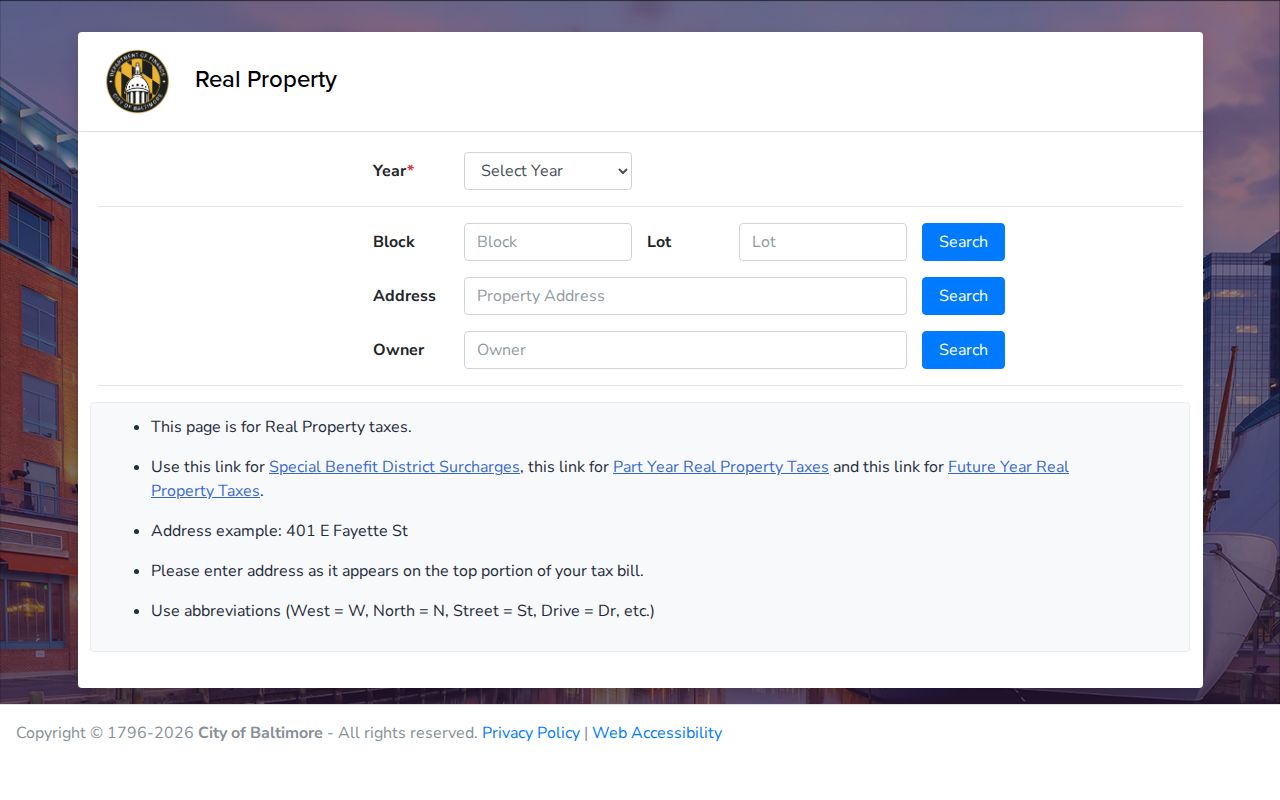
The owner field sits beside address and block-lot routes, so a result can be carried into the assessment and deed systems without treating tax ownership as occupancy.
| Known fact | Baltimore search | Next check |
|---|---|---|
| Owner name | City tax portal | Block/lot and deed |
| Street address | SDAT or CityView | Tax account and permits |
| Block and lot | Tax portal or MDLandRec | Recorded instrument |
Baltimore Block Numbers Bridge Time
A Baltimore block number can outlast a renamed street or changed house number. The block-index system was ordered in 1886 and applied backward to transactions from 1851. New block ranges also reflected the 1888 and 1918 annexations. That history makes the block more than a parcel code. It is a bridge between current tax data, block books, old assessments, and deed references.
In land records, a grantor transfers an interest and a grantee receives it. A liber and folio are the deed book and page. Start with a current address, capture the block and lot, open the oldest available deed, then follow its prior liber and folio into the next volume. Historic grantor, grantee, and unlocated-conveyance indexes can carry the chain farther back when an exact address fails.
MDLandRec opens with a free account and Baltimore City selection.
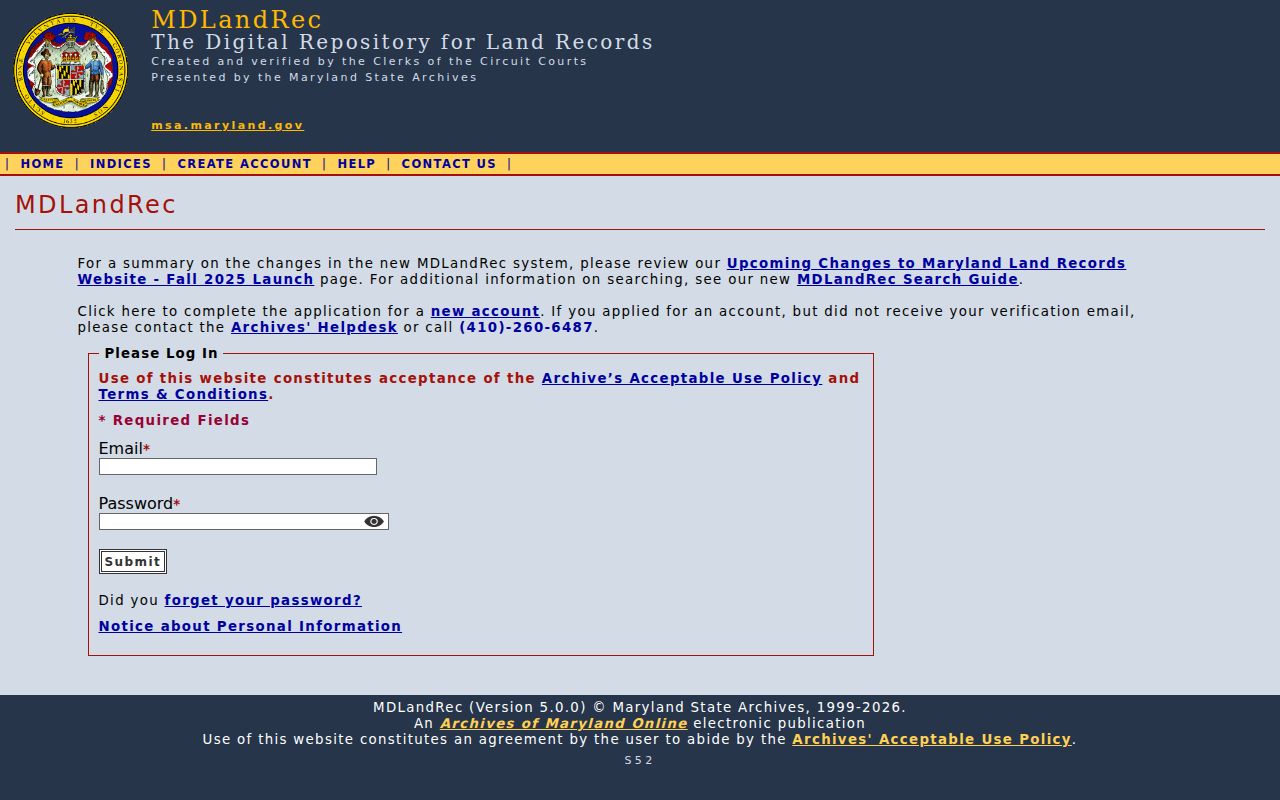
The portal's block, address, and volume paths show why preserving each identifier is more reliable than repeatedly searching one modern street form.
- Block and lot
- Baltimore parcel identifiers used across tax, map, and land systems.
- Liber and folio
- The book and page where a recorded instrument appears.
- Situs address
- The physical property address, which may differ from an owner's mailing address.
Baltimore Court Records by Name
Maryland Judiciary Case Search accepts a person, company, or case number and can be narrowed to Baltimore City, court system, case type, and filing dates. Results identify the case number, party and role, court, case type, status, filing date, and caption. A docket is the dated list of activity in a case. It can point to the right file, but the free web result is only a summary.
Public documents that are absent remotely may still be available at an MDEC courthouse kiosk or from the filing clerk. Dismissed, acquitted, nolle prosequi, and older stet matters can disappear from remote search while remaining open at the courthouse. Sealed, shielded, expunged, juvenile, adoption, and other restricted material follows separate rules. Bring a case number when possible and ask for the named document rather than an undefined search.
| Baltimore court | Main subject | Public route |
|---|---|---|
| Circuit Court | Major civil, criminal, family and appeals | Case Search, kiosk, clerk file |
| District Court | Limited civil, traffic and criminal | Case Search and filing location |
| Orphans' Court | Probate and estates | Register of Wills and court |
| U.S. District Court | Federal cases | PACER and courthouse |
Note: A name match is a lead, not identity proof; compare date, party role, address, court, and case chronology.
Baltimore Vital Records and Certificates
Baltimore City does not issue local vital certificates. The Maryland Division of Vital Records handles modern certified products, the Circuit Court holds local marriage and divorce court records, and the Maryland State Archives supplies historical Baltimore City series. Access depends on the record, its age, the requester's relationship, identification, and the product sought. A divorce verification gives basic event facts; it is not the court's decree.
Baltimore's civil birth and death registration began in 1875, twenty-three years before Maryland's county system. MSA holds Baltimore City births from 1875 through 1924, with birth access restricted for 100 years or until the named person's death. Before 1875, trace an address in a directory, find nearby churches on a period map, and search church registers. Marriage indexes start earlier, in 1851.
Modern birth applicants may include the named person, a named parent, a qualifying guardian, an authorized representative, or another person allowed by law. Death requests also require a qualifying relationship or legal need. Confirm current eligibility and fees with the Division of Vital Records fee page before ordering.
Baltimore Business Name Search
A current or former business can connect a name to a dated public role. Maryland Business Express searches by business name, Department ID, or EIN. Detail pages may show status, principal office, resident agent, formation facts, and filed documents. A resident agent receives legal process for the entity; that role does not by itself mean the person owns or operates the business.
Use the filing date and role as boundaries. Then compare a public professional license or a city permit when the trade matters. The Maryland Labor universal query searches surnames across many boards, while physicians, nurses, and attorneys have their own official portals.
The Business Express screen shows its three distinct query modes.
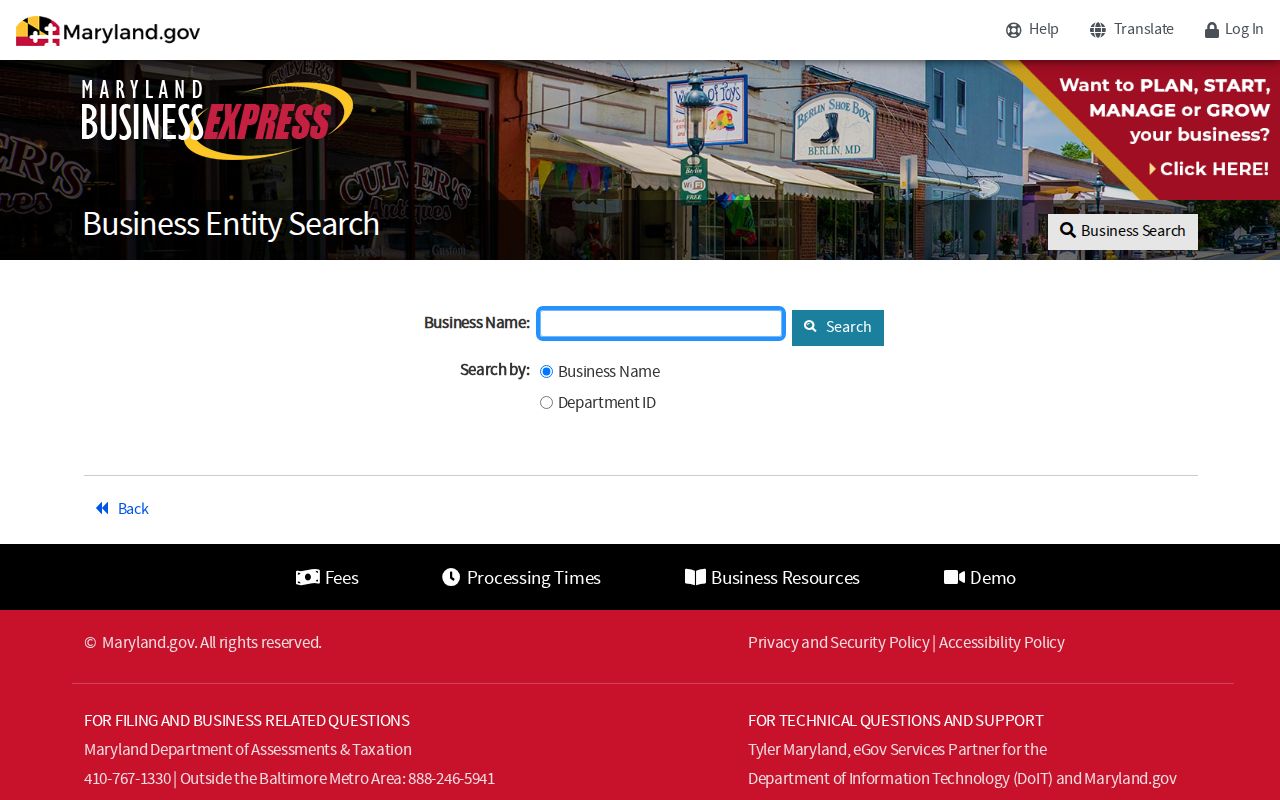
Department ID is the cleanest follow-up once a likely entity is found because similar business names can otherwise blur separate filings.
Baltimore Detention Search Limits
Baltimore detention is state-operated, so there is no conventional county jail roster. The Maryland DPSCS Incarcerated Individual Locator is the official name route. It warns that some people are omitted, including certain short-sentence populations, people held only on District Court bench warrants, and people committed to mental-health facilities. A failed search therefore does not prove a person is not held.
The locator is best used for current location and custody context. Court history belongs in Maryland Judiciary Case Search, while release notification runs through the state's VINE service. The sex offender registry is a separate public system with its own warnings and must not be treated as a complete safety assessment.
The official locator pairs its name fields with a coverage notice.
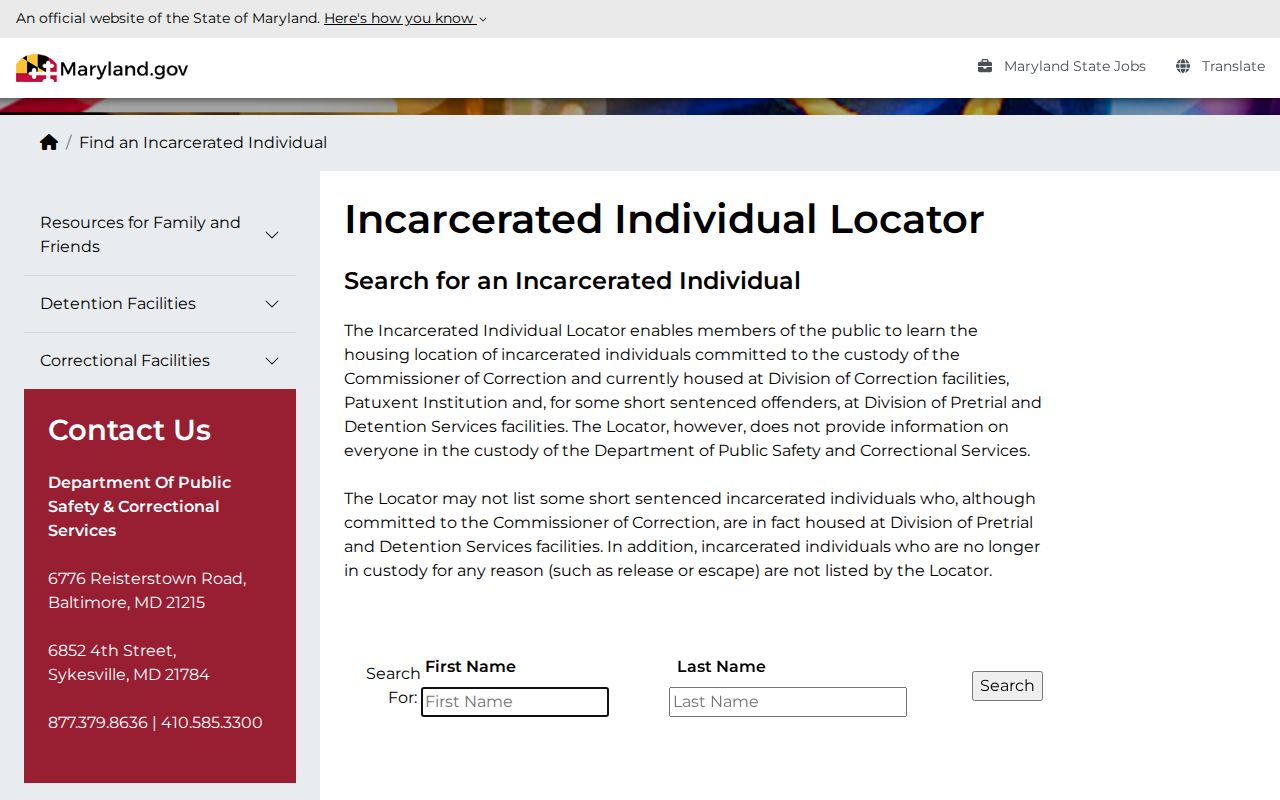
Read the omissions before drawing a conclusion from no result, and use any returned identifier to distinguish people with similar names.
Baltimore Probate and Heir Records
Estate research often links the Register of Wills, Orphans' Court, land records, and newspapers. Begin with the decedent's full name and death range. An estate case can identify a personal representative and docketed filings. A deed may recite an estate transfer or prior ownership. An obituary can add relatives, but it should be checked against the probate file and recorded instrument.
The Orphans' Court and Register of Wills operate at 111 N. Calvert Street. Search or contact the office with the name and approximate date, then preserve the estate number. For an inherited parcel, compare that file with the Baltimore block and lot and the deed's liber and folio. Mailing addresses may help distinguish heirs, but they should not be assumed current.
Baltimore Directories Before Incorporation
The Baltimore City Archives lists a city directory from 1752, decades before the 1796 charter. Later holdings include ordinary resident directories, business books, social registers, Black business directories, transit editions, and suburban volumes. Edition type matters. Absence from one book does not mean absence from Baltimore.
The Enoch Pratt Maryland Department adds city and reverse directories, early telephone books, maps, newspapers, photos, biography cards, and clipping files. Reverse volumes are especially useful when an address is known but an occupant is not. Search surname variants, initials, spouse, occupation, employer, and address, then compare the entry with a dated official source. The dedicated Baltimore people directories reference distinguishes current staff searches from these historic collections.
Baltimore WPA Name Card Search
In the 1930s, the Baltimore City Archives' WPA Historical Records Survey built an alphabetical card index to names scattered across selected municipal papers. The underlying records were reorganized in 1982, but item numbers were retained. That makes each scanned card a rare person-first bridge into collections otherwise arranged by office or subject.
Search the WPA name-card scans, save the spelling and item reference, then translate it through the current record-group guide. A card is an index entry, not the full evidence. Request the cited item from the archives and record its creating office and date.
Archive access has more than one route. A researcher can schedule a reading-room appointment, ask staff for remote research, order scans, or use a personal camera during an approved visit. Appointment requests ordinarily identify the subject and record series at least three business days ahead, and archive registration calls for photo identification. The Baltimore City Archives also lists individualized research at $35 per hour, scans under 100 pages at $35, and larger scan orders at $50. Those services matter when the card points to an undigitized item. Ask staff to confirm current access and reopening status before travel because the announced renovation affects in-person use, while phone and email service continue.
Note: Baltimore City Archives announced a renovation closure beginning April 27, 2026, with phone and email research help continuing during the closure.
Baltimore Search Privacy Boundaries
Public access is not a license to harass, stalk, impersonate, threaten, or defraud anyone. Protected voter addresses, recent vital certificates, juvenile and adoption files, sealed court material, motor-vehicle data, and sensitive identifiers have separate limits. Maryland's voter lookup is an authenticated self-service tool, while bulk voter data goes only to a Maryland registered voter who swears to electoral-process use. Full treatment appears in the voter records page.
Commercial profile removal does not erase government records. Maryland's Online Data Privacy Act lets residents exercise rights against covered private controllers, but excludes public information and government bodies. Correct a wrong deed, docket, assessment, or voter entry through the custodian's own process. For anything compiled elsewhere, save the source, date, and disputed field before requesting correction or deletion.