
Checking Baltimore Voter Registration
Use the Maryland Voter Lookup to check a registration tied to a Baltimore City residence. It is an authenticated self-lookup, not a public name directory. First and last name, date of birth, and the five-digit residential ZIP on the registration must match the state record. A middle initial and street number can narrow the result but are optional.
Enter the name as it appeared on the registration form. For a recent move or name change, try the former ZIP or former name if the current facts return no match. The state updates the service daily, yet a submission made the same day will not appear at once. Online and Motor Vehicle Administration changes can take up to three weeks.
| Lookup field | Entry type | Required? | Baltimore search rule |
|---|---|---|---|
| First name | Text | Yes | Use the registered form; letters and spaces only. |
| Middle initial | Text | No | One alphabetic character. |
| Last name | Text | Yes | Letters, hyphens, and spaces are accepted. |
| Date of birth | Three numeric inputs | Yes | Enter month, day, and year. |
| ZIP code | Numeric text | Yes | Exactly five digits from the residence on record. |
| Street number | Text | No | Fractions are unnecessary; common separators are allowed. |
The official lookup screen makes the required fields clear. View the live voter search before entering private details.
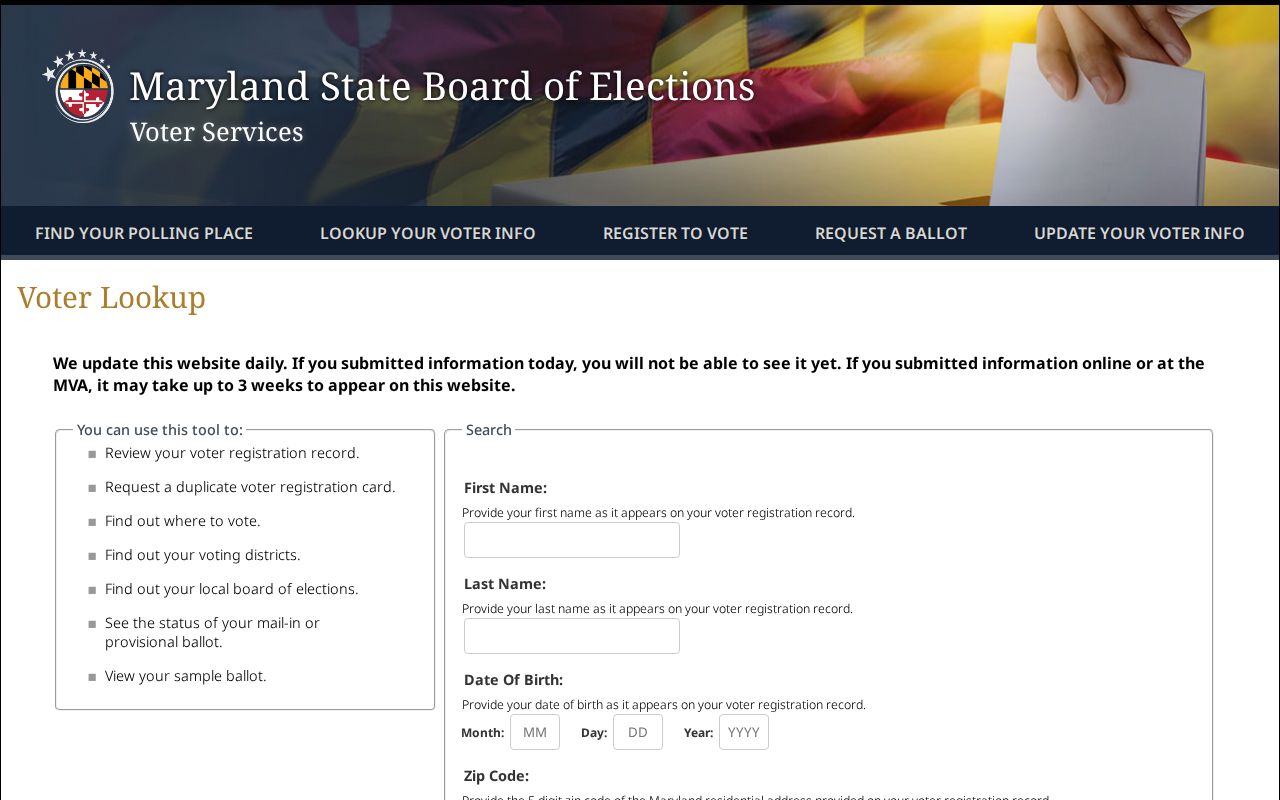
The screen reinforces why a partial name alone cannot reveal a Baltimore voter record. If known details still fail, contact the local election board through the service rather than guessing repeated combinations.
Baltimore Voter Lookup Results
A successful self-lookup does more than confirm voter registration. The service can display the assigned polling place, election districts, local board information, a sample ballot, and the status of mail-in or provisional ballot activity. It can also support a request for a duplicate registration card. These are voter services tied to the authenticated record, not an export of the city roll.
The distinction protects both accuracy and privacy. A polling place can change, district lines can be revised, and ballot status is time-sensitive. Check the current result close to the election instead of relying on an old screen capture or copied address. Baltimore City is its own election jurisdiction and county-equivalent. A postal address that says Baltimore does not prove the voter belongs in Baltimore City rather than Baltimore County.
Can voting history reveal a ballot choice? No. Maryland records participation, such as the election and voting method, but the secret ballot does not become part of a voter record.
Note: A current official result is more reliable than a saved card when polling locations, districts, or ballot status may have changed.
Fields in Baltimore Voter Records
The statewide list created under Election Law § 3-101 carries identity, address, registration, status, party, precinct, and district data. It must retain at least five preceding years of current voting history. The downloadable registration file is broader than the self-lookup result, but access to it is restricted.
| Identity | Voter ID, name, party, and gender. |
|---|---|
| Addresses | Residential and mailing addresses, except a protected residence address. |
| Registration | State and county registration dates, county, and active or inactive status. |
| Political geography | Split, precinct, ward, and congressional, legislative, councilmanic, municipal, and commissioner districts. |
| Participation history | Election, type, party, method and date, precinct, and early-voting site, never ballot selections. |
Status shows whether a registration is active or inactive. Precinct identifies the local voting area. Participation history shows that a person took part, while the content of the marked ballot remains secret. These field limits are vital when reading a list without drawing a false conclusion.
Baltimore Voter Privacy Boundaries
Maryland Election Law § 3-506 draws a firm line around distribution. Only a Maryland registered voter who files a written application and sworn statement may receive a voter list. The stated purpose must relate to the electoral process. The downloadable list is not a general-purpose people directory.
Confidential under Maryland law. Address-confidentiality-program residence addresses are suppressed automatically. The application office and a decision not to register are confidential under Election Law § 3-202, while Social Security and MVA credential numbers are not downloadable-list fields.
Maryland also publishes a voter confidentiality form, identified by the State Board of Elections as updated March 3, 2025. That separate safety route should not be confused with automatic suppression for address-confidentiality-program participants. Current privacy protection belongs in the voter record workflow, not as an afterthought.
Baltimore Voter File Choices
The standard registered-voter file is only one product. Maryland also offers walking, permanent mail-in, single-election mail-in, provisional, early-voting, and cure lists. Product choice changes both layout and fields. Requesters should select the smallest file that serves the permitted election task.
- A walking-list PDF sorts voters by precinct and street, places even and odd addresses on opposite sides, and shows residents and party.
- Mail-in files add voter ID, residential, mailing and ballot addresses, precincts, districts, dates, party, type, status, and county.
- Early-voting data adds the location and date, ballot style, precinct, and gender.
- Provisional lists add status and reasons, jurisdiction, polling precinct, ballot issue, and ballot styles.
- Cure data tracks old and new ballot statuses, reasons, sources, envelope types, and the change date.
Except for walking lists, files arrive as tab-separated text without delimiters. The State Board provides no custom format, compatibility work, or technical support. A program that can import tab-separated values is useful, but the recipient remains responsible for handling every row within the sworn limits.
Ordering Baltimore Voter Registration Data
Use the State Board of Elections' Voter Registration List Request Form, revised June 30, 2026. A single Baltimore City file costs $75. Statewide data costs $125, and a single district costs $75. The applicant must be registered in Maryland and supply a voter registration number, contact details, residence, requested geography, product, filters, delivery choice, and signed oath.
- Choose Baltimore City, the list product, and valid filters. A request can select active voters, registration dates, certain parties, or all parties including inactive records.
- Select history. Five elections may be included, or a separate history can cover up to ten elections from the choices shown on the form.
- Sign the oath against commercial, non-electoral, transfer, sale, or distribution uses. Identify any organization buying the file.
- Pay in full by an accepted credit card, certified, personal, or campaign check, or money order payable to the State Board.
- Choose free FTP delivery with email notice or add $15 for a flash drive delivered to an approved address or picked up.
The state purchasing page summarizes eligibility, cost, and delivery. Its captured screen gives useful context for the current request process.
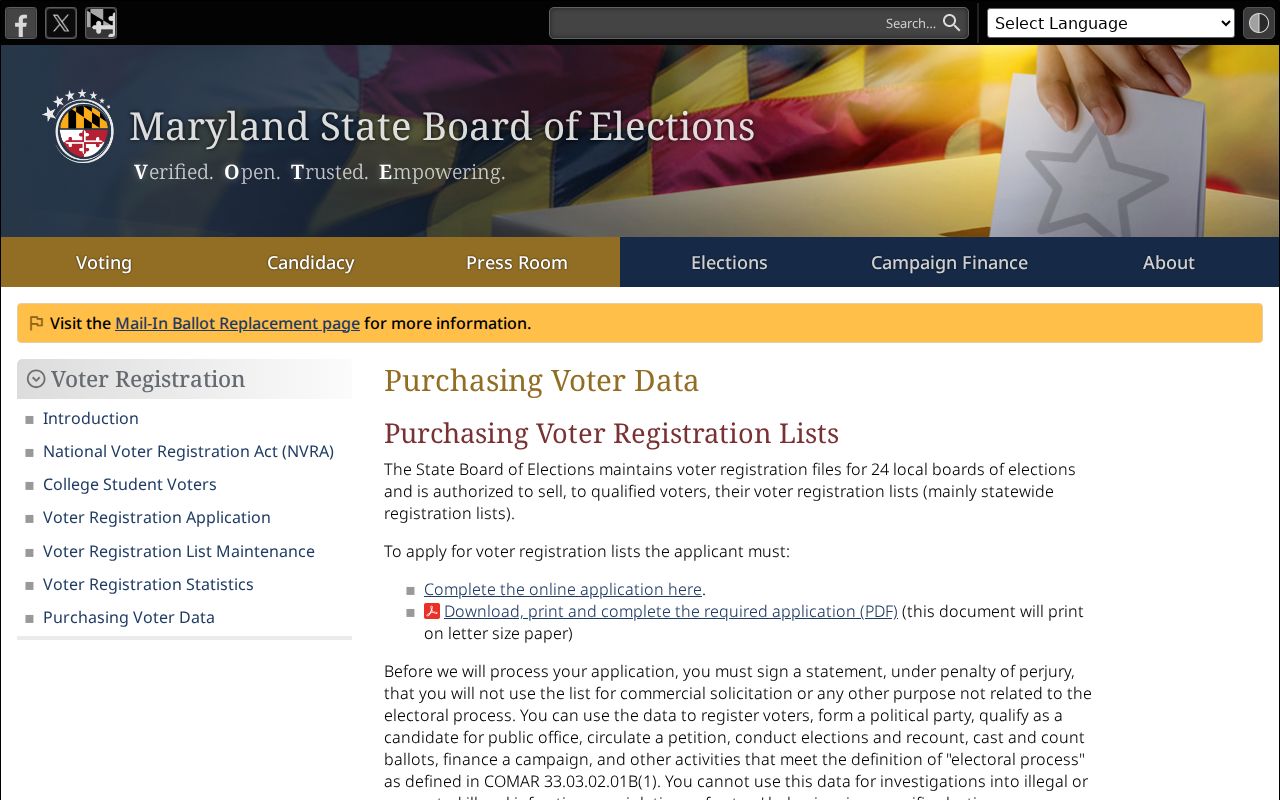
The current form controls when details differ from old summaries. It says FTP is free and a flash drive adds $15, replacing stale references to an older setup charge.
Baltimore Voter Request Timing
The State Board says voter-data orders are turned around within ten working days. Timing tightens near an election. Under COMAR 33.03.02.05B, a request must arrive by the advanced-registration deadline, 21 days before election day, or wait until after election day. That cutoff should be built into any lawful election project.
Payment must be complete. A returned check carries a $30 fee. Questions about the state file go to 410-269-2840 or dlPSR_sbe@maryland.gov. Use the state form and contact for this product, and confirm local counter hours or any separate local pricing before relying on them.
Note: Submit well before the cutoff because the ten-working-day turnaround does not promise delivery before a campaign deadline.
Baltimore Voter Roll Status
Active, inactive, and cancelled do not mean the same thing. An inactive entry remains part of voter registration administration, while cancellation removes the registration under set grounds. The full file request can include all parties and inactive voters, or filter to active records. That choice changes the group being studied.
Election Law § 3-501 permits removal only after an authenticated signed request from the voter, death or another loss of eligibility, a confirmed out-of-state move handled through the statutory process, or an administrative disqualification. A missing self-lookup result is not proof of cancellation. Exact-name errors, a former ZIP, processing lag, or jurisdiction confusion can cause a nonmatch.
The daily lookup and periodic voter file answer different questions. Use self-service for one's current registration and election details. Use an ordered file only for the electoral purpose sworn to in the application.
Baltimore Voter Records Misuse
The voter-file oath bans commercial solicitation, non-electoral use, and sale, distribution, or transfer of the data. Knowing misuse is a Maryland misdemeanor. The current form states a penalty of 30 days to six months, a fine up to $250, or both. Public access within a restricted process does not permit repeated unwanted contact, threats, surveillance, impersonation, or fraud.
Use the roll only as sworn. Election Law § 3-506 limits the file to electoral-process use, and Maryland stalking, harassment, fraud, and identity-theft laws can apply to harmful conduct.
Suspected list misuse can be reported through the State Board voter-data office or the local board. For the broader access-law frame covering other agency material, consult the Baltimore public records process. Voter rolls remain governed by their own election-law limits.